A well-organized classroom supports the teacher’s movement, student interaction, and frequent Checks for Understanding. The goal is simple:
Students should always be able to face the teacher and the screen during instruction.
The Golden Rule: Students Face the Teacher and Screen
During instruction, students need a clear view of both the teacher and the instructional screen. This allows students to see explanations, examples, modeling, visuals, gestures, and other instructional cues.
When students must turn their bodies or twist around to see the teacher or screen, attention can be lost. Students may also have difficulty following modeled examples or participating in Checks for Understanding.
An effective classroom layout allows students to quickly shift their attention between:
- The teacher
- The instructional screen
- Their classmates
- Their own work
The layout should support instruction.
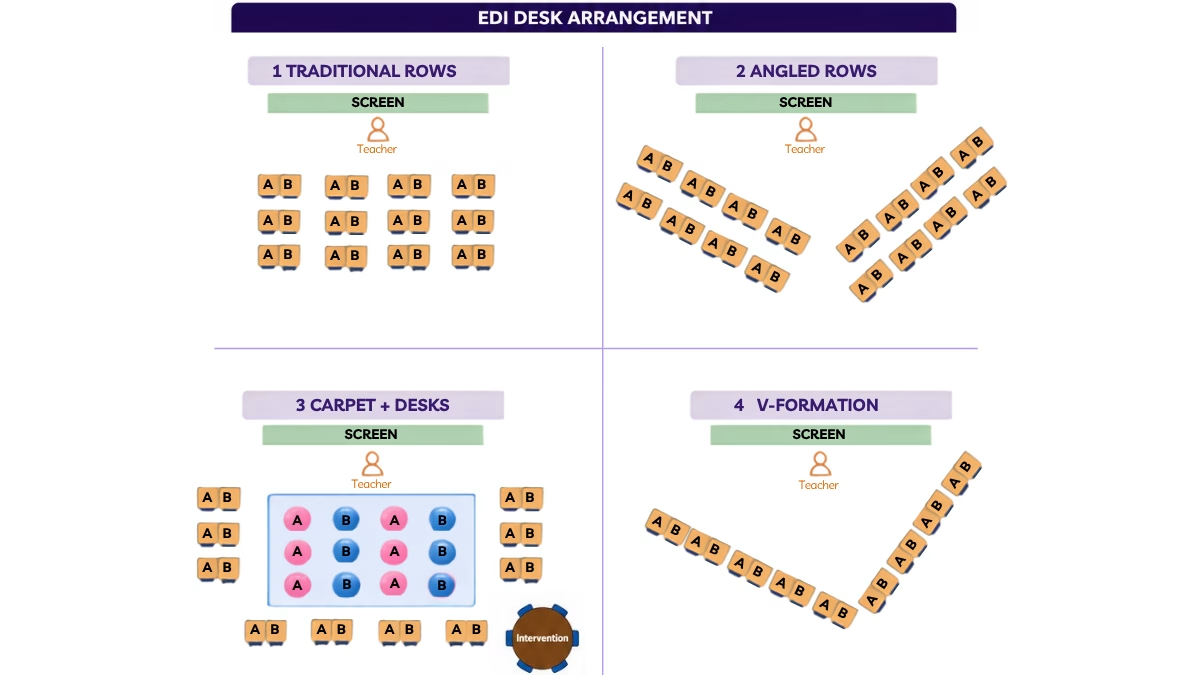
Four EDI-Friendly Desk Arrangements
There is no single desk arrangement that works for every classroom. The best arrangement depends on the room, grade level, lesson activities, and number of students.
However, several arrangements can support EDI particularly well.
1. Traditional Rows
Traditional rows can work well when students need to focus on the teacher and screen.
Rows provide clear sightlines and make it easy for students to face forward during direct instruction.
The challenge is that rows can make student interaction more difficult. Teachers may need to intentionally build in opportunities for students to turn and Pair-Share.
2. Angled Rows
Angled rows can provide students with a better view of the teacher and screen while creating more opportunities for interaction.
The angle can also help students orient themselves toward the instructional area while maintaining access to nearby classmates.
3. Carpet + Desks
For elementary classrooms, combining a carpet area with desks can provide flexibility.
Students can gather in a common area for portions of instruction and then transition to desks for guided or independent practice.
The key is to ensure that students sitting on the carpet can still see the teacher and instructional screen.
4. V-Formation
A V-formation allows students to face toward the instructional area while maintaining opportunities for interaction.
This arrangement can be particularly useful when teachers want students to maintain a forward-facing orientation while still having access to partners.
Classroom Layouts to Avoid
Some arrangements create unnecessary barriers to engagement.
For example, students sitting in clusters that face one another may have difficulty seeing the teacher or screen. This can be especially problematic during direct instruction.
Another concern is placing students in positions where they have their backs to the teacher or must turn around to see the instructional area.
The issue isn’t that group seating is always ineffective. The issue is whether the arrangement supports the instructional task.
If students are expected to listen, watch a demonstration, respond to questions, or participate in TAPPLE, they should be positioned so they can easily see the teacher and screen.
The Bottom Line
Classroom organization is an instructional decision.
For Explicit Direct Instruction, the physical environment should support the teacher’s ability to teach clearly, check for understanding, monitor learning, provide feedback, and keep students actively engaged.
Whether a classroom uses traditional rows, angled rows, a carpet-and-desk combination, or a V-formation, the most important principle remains the same: