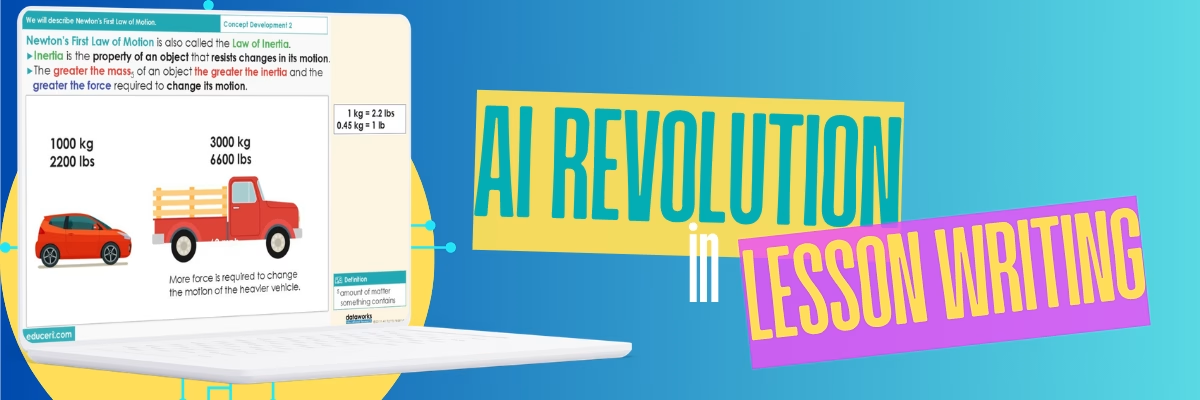
How AI is Revolutionizing Lesson Writing for Teachers
In today’s fast-paced educational environment, teachers are often tasked with balancing lesson preparation, teaching, grading, and administrative work. As a result, finding ways to streamline lesson writing while maintaining quality is essential. One powerful tool that has emerged to help with this is Artificial Intelligence (AI). The use of AI in lesson writing has proven to be a game-changer, increasing efficiency and significantly reducing the time required to craft comprehensive, publishable lessons. In fact, we have been able to reduce lesson writing time by up to 60%. Here’s how AI is transforming the process, particularly when combined with the Explicit Direct Instruction (EDI).
Explicit Direct Instruction (EDI) emphasizes clear, concise teaching with a strong focus on guiding students through a structured learning process. One of the most time-consuming parts of lesson writing is finding suitable reading materials that align with the specific learning objectives. AI can automate this process by selecting passages based on predetermined criteria.
1. Selecting Passages to Match Specific Criteria
For example, when designing a lesson for the standard RI.11-12.5, which asks students to assess how an author’s structure contributes to the meaning of a text, AI can choose multiple passages that use the same topic but vary in structure. This approach helps to increase the complexity of the lesson, allowing students to explore different forms of writing while evaluating the effectiveness of an author’s structure.
2. Simplifying Language Conventions
Lesson writing also involves making language accessible to students while still adhering to educational standards. AI can help identify the most frequently used rules, conjunctions, prepositions, and other parts of speech to reduce students’ cognitive load. By automating this selection, AI ensures that students are exposed to the correct and current usage of conventions.
When writing a lesson to meet the standard L.11-12.1a, reducing cognitive load makes it easier for students to process and retain information, leading to improved learning outcomes.
3. Incorporating Unique Figurative Language
In literature, figurative language plays a crucial role in adding depth and richness to texts. However, using the same types of figurative language repeatedly can lead to a sense of monotony in lessons.
AI can identify unique uses of figurative language, such as metaphors and similes, from a variety of texts. By diversifying the types of figurative language in text, AI keeps students engaged and re-energizes their learning experience.
4. Introducing Diverse Cultures and Perspectives
AI can be particularly beneficial in selecting literature that is in the public domain, which often contains works from various cultures and time periods. By incorporating a wider range of literature, AI helps expose students to diverse cultures, traditions, and perspectives. For example, the standard RL.9-10.6, which asks students to analyze how cultural experiences are reflected in world literature. It’s a simple yet powerful way to foster global awareness and empathy among students.
5. Creating Excerpts for Deeper Understanding
To ensure students gain a comprehensive understanding of literary concepts, AI can break down longer works of literature into manageable excerpts. These excerpts are designed to expose students to a variety of ideas and themes, helping them develop a deeper understanding of complex concepts. By focusing on smaller sections, AI ensures that students not only grasp individual concepts but can also apply them to larger works of literature. This approach aligns with the RL.9-10.3 standard, which focuses on analyzing characters’ internal and external conflicts.
6. Tailoring Passages to Grade-Level Interests
Engagement is crucial for student learning, and AI can help by selecting passages that resonate with students’ interests. By considering the specific needs of different grade levels, AI can tailor the content to ensure it is relevant and engaging. This personalized approach is reflected in the W.9-10.8 standard, which emphasizes the importance of assessing the usefulness of information from multiple sources. With AI, students are more likely to engage with the material because it speaks to their personal interests and academic level.
7. Varying Mathematical Word Problems
Mathematical problem-solving can be challenging for students, and providing a range of problems is essential for reinforcing key concepts. AI helps by selecting multiple word problems with varying language complexity. This approach ensures that students develop a well-rounded understanding of mathematical concepts, from basic principles to advanced problem-solving skills. By using AI to diversify word problems, we align with the 7.RP.2.C standard on solving proportions.
8. Ensuring Accuracy in Problem Solving
For math lessons, accuracy in problem-solving is crucial not just for student success but also for building confidence. AI helps by checking answers and ensuring the accompanying processes are accurate. This step ensures that students receive the correct feedback and can learn from their mistakes. It also provides teachers with the tools they need to support students effectively. This aligns with the 7.EE.4.A standard on solving two-step equations, empowering students to improve their mathematical skills and succeed in more complex problems.
Conclusion
The integration of AI into lesson writing is transforming the way teachers create and deliver lessons. By automating time-consuming tasks, AI allows educators to focus more on student engagement and personalized teaching. With its ability to analyze text complexity, simplify conventions, introduce diverse perspectives, and ensure accuracy, AI is not just a tool for efficiency—it’s a tool for enhancing the quality of education. When paired with EDI strategies, AI helps to create a structured, engaging, and effective learning environment where all students can thrive. As more educators adopt AI-driven lesson writing, the future of teaching will become even more dynamic, accessible, and impactful for students.